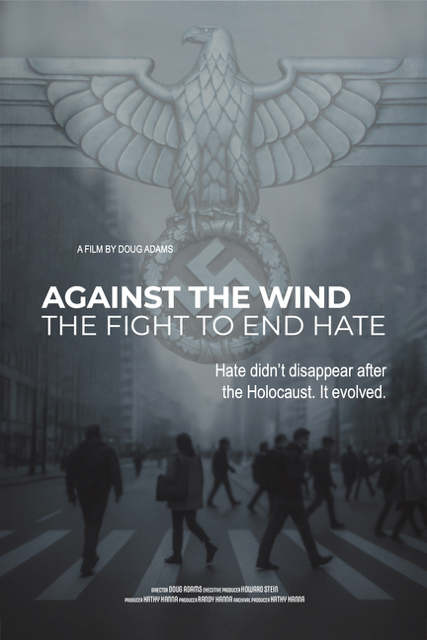

On April 12, 2026 a new film was screened at Thalian Hall in Wilmington, NC for a full house. People of different backgrounds saw a film that had the power to change them, a film that summarized the history of antisemitism and other forms of hatred, depicting the power of words to forge a hateful Nazi ideology and propaganda, to build a ruthless killing machine. But Against the Wind also convincingly showed the power of language to counteract hate and connect us to each other. The film presented some ways, often small and do-able for ordinary folks, in which words could challenge this ideology, resist global movements of hatred and violence, and turn peoples' hatred into tolerance of difference.
Against the Wind: The Fight to End Hate is directed by Doug Adams, an independent documentary filmmaker. The film's executive producer is Howard Stein, a longtime supporter of the Wilmington Jewish Film Festival and of Holocaust education for local high school students and UNC Wilmington students. These young people need to be educated about the many kinds of hatred in the world and to stand up to them. Because the film depicts current outbreaks of antisemitism and sets these against Holocausts in Rwanda, Bosnia, and Cambodia, it offers students and other filmgoers a universal and timely lesson in how to resist hatred in all its forms. The film encourages us to become agents of change, "upstanders," not bystanders to violence and hate.
I left Thalian Hall not in despair, but encouraged to be an upstander in some small ways. This is in no small part due to Doug Adams, who, as is said in his biography, "approaches the subject not only as a historical inquiry but as a civic responsibility." As Rabbi Robert Waxman observes, "the film achieves a balance between its horrific images of Holocaust history that shock people and its urgent call to action against hate."
Other compelling elements of the film were the discussions by scholars of Social Darwinism and eugenics, doctrines spawned in the 19th century, that created a vocabulary where dehumanization of Jews became acceptable, as well as the testimonies of resistance fighters and other survivors, sometimes retold by their offspring. Beth Lippman, daughter of survivor Basia Lemberger, movingly spoke of her mother's quick-wittedness and sheer luck while imprisoned in a concentration camp. Sheer luck and resourceful flirting with Nazi officers also saved resistance fighter Carla Peperzak, who was carrying fake Jewish identity papers in a suitcase when they stopped her. These chilling tales and information about events that are offered not only through scholars' research but also through carefully selected historical artifacts create a film that Holocaust-deniers cannot turn away from.
The often angry language of the film rails against what the Nazis were doing in Auschwitz as "industrialized murder" and "a killing factory," and the narrator's clear tone of moral outrage here as well as when he labels Nazi propaganda as "genocidal ideology" also contribute to the film's power.
In addition, a unique aspect of the film (and I have seen a number of films about the Holocaust and antisemitism that lack this aspect) is the space it gives to two former neo-Nazis who describe their path from fomenting hatred to becoming de-radicalized advocates for tolerance. Tony McAleer sheds his antisemitism and in his bio calls himself a "change maker." He points out the influence of social media on the radicalization especially of young detached, angry, and disaffected males.
The words of the second de-radicalized neo-Nazi, Jeff Schoep, especially stayed with me; he called himself a "peacebuilder" in the film and this rang true to me.
As Doug Adams has written of Schoep, "Jeff Schoep . . . served as national leader of the National Socialist Movement for 25 years and was involved in neo-Nazi activity for 27 years. His experience offers direct insight into how extremist movements recruit, retain members, and reinforce identity and loyalty. It also reflects the personal drivers behind radicalization, including the search for belonging, recognition, and control." Schoep discusses how he comes to see "the humanity of those he had once demonized," and in the film describes his emotions after his epiphany: the "guilt, shame, regret, sorrow and heartbreak." His transformation after 27 years is sincere and believable. As one filmgoer in Wilmington, Amy Ostrower, said to me, Schoep's story allows us to believe that people can change for the better.
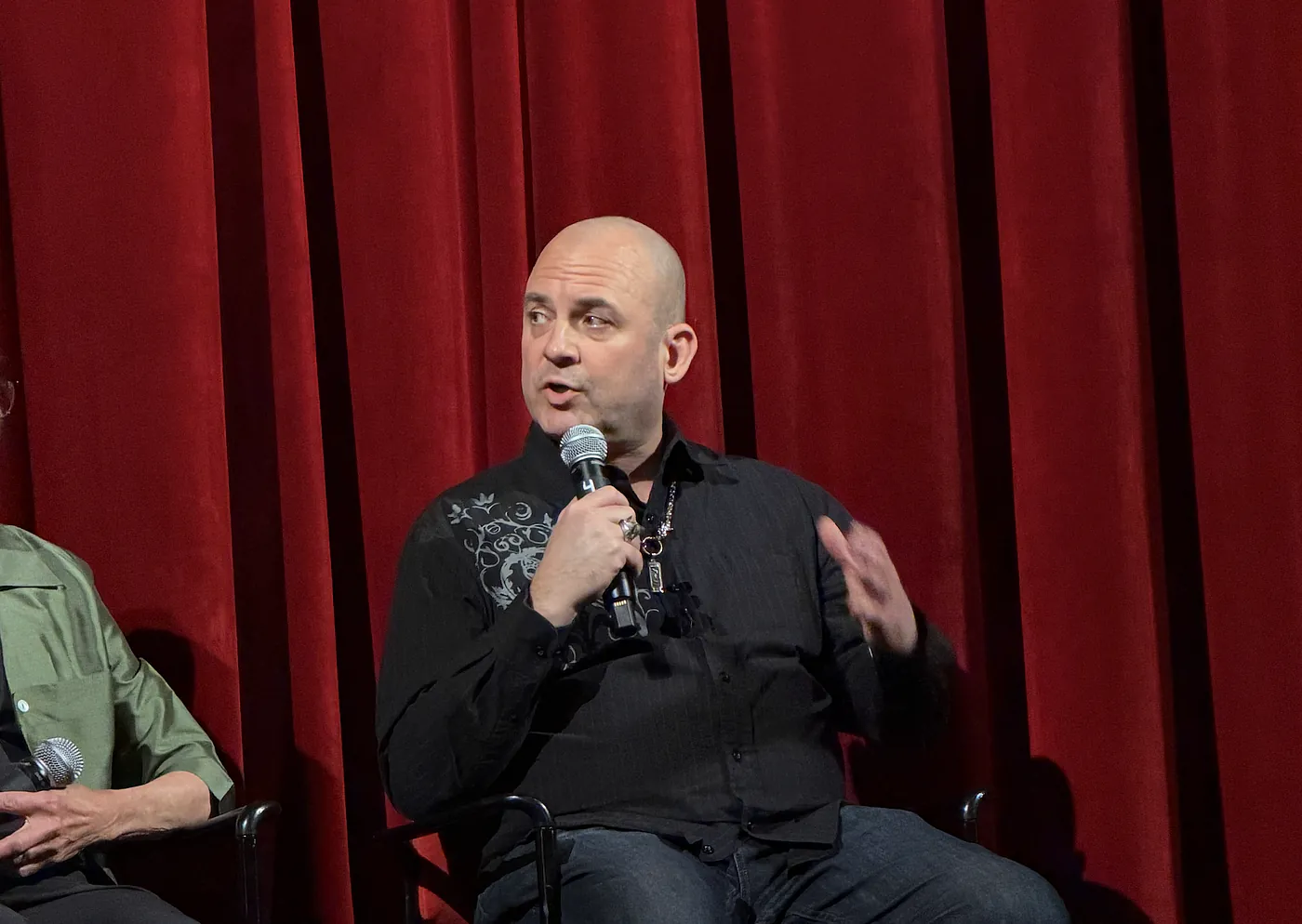
Schoep's credibility and persuasiveness were also reinforced in the interview and discussion that followed the screening of the film in Wilmington, when he discussed his process of reversing a 27-year career of hate-mongering through outreach and education of audiences that might transform them into peacebuilders too. Because a couple of earnest and articulate high school students were interviewed in the film about the Holocaust and antisemitism, Schoep's and others' goal of educating the next generation about the Holocaust and antisemitism to combat hate seems even more credible.
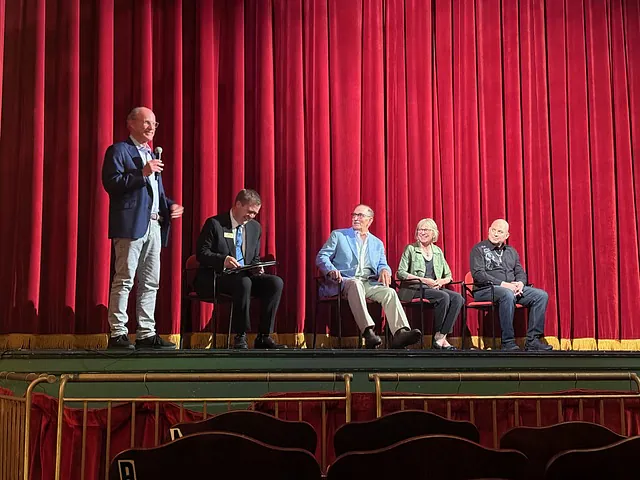
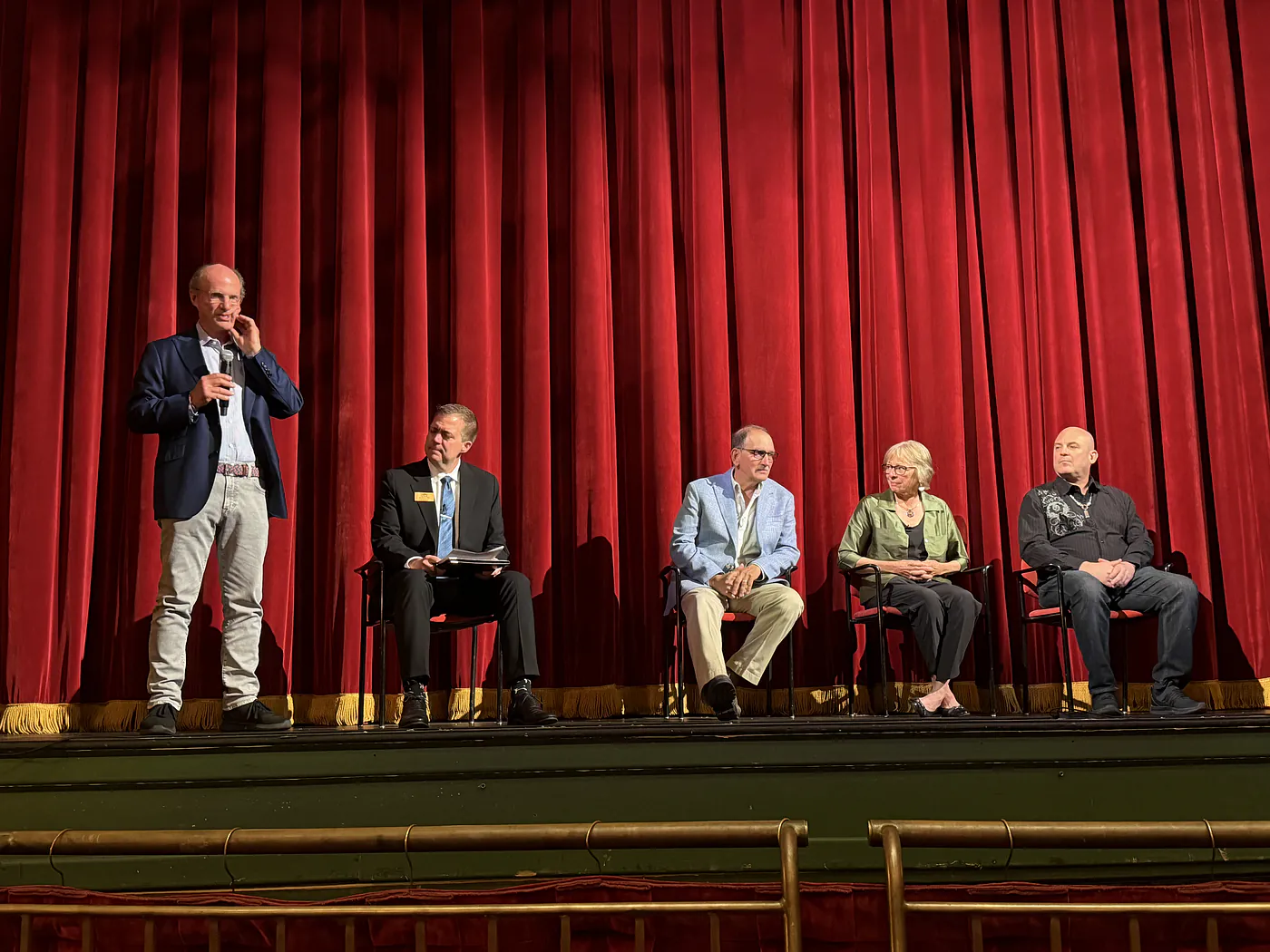
Kathy Hanna, another producer of the film and its archivist, was also present for the discussion after the screening at Thalian. She spoke eloquently about being an upstander not a bystander. As her bio posits, her selection of verified artifacts for the film reveals her purpose and a key purpose of the film: "By grounding the film in verified historical record, her goal was to ensure that the origins and mechanisms of antisemitism and hate speech were seen accurately, and that the continuity between past and present is unmistakable." These artifacts and the testimonies in Against the Wind effectively undermine the claims of Holocaust-deniers.
Finally, the facilitator of the discussion, Dr. Aaron King, a political scientist at UNCW, effectively framed questions for the other three participants, fostering a discussion that was productive and transformative.
I left Thalian Hall with some tools to resist hate. I am grateful to Doug Adams and his whole crew for Against the Wind for giving us a sense of urgency and agency, for equipping audiences, in some small measure, to repair the world.